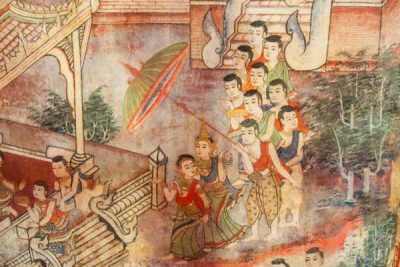
Originating strictly as a religious form, traditional Thai art is often associated with Buddhism and the sangha – the community. There are some good books on sale, such as William Warren and Ping Amranand’s Lanna Style: Art & Design of Northern Thailand, which is a well illustrated coffee table book introducing the complexities of the form.
Simply put, the art commonly told stories of the era involving everyday village scenes and survives mostly in mural form, with a distinctive style for characters and use of colours. These charming displays of ancient Lanna life can be best seen at Wat Chiang Man, and Wats Lai Kham and Prasat – both near Wat Phra Sing.
Another distinctive art form in Thailand is the relief, intricately carved from wood to produce impressive three-dimensional detail. Thais are exceptionally gifted at this and pieces, large and small, are seen in abundance at Baan Tawai craft village. The area is famous for its wooden carvings, furniture, filigree work and more.
Thai architecture
The most distinctive style of Thai architecture is seen in the many temples all over Thailand. Chiang Mai has no shortage of these, conspicuous for their steep stuccoed roofs and ornate filigree.
The wihaan (main hall) may have as many as five roof levels and distinctive lips. The entrances are often guarded by nagas, mythical snake-like serpents with ferocious heads. Throughout the ages the styles of chedis and Buddha images have also changed, and subtle or distinct differences indicate the art period, ranging from Mon through to Lanna, Lopburi, Sukhothai, Ayuthaya and the current Ratanakosin era.
Many of the traditional houses in Thailand, and which are found in Chiang Mai, are constructed of wood and are on stilts. However, there is less emphasis on beating the heat, due to the milder climate. There are many of these found in Chiang Mai, and by simply wandering the back streets of the old city, you can admire their simple but effective design and exquisite finish. Many have been turned into guesthouses, complete with traditional wooden and rattan furniture. All can be distinguished by the decorative ‘galares‘ (cross-sword displays) that sits on the apex of the roof – forming an archetypical Northern Thai symbol.
Thai dance
Thai traditional dance is one of the truly graceful aspects of the country and is quite symbolic of the Thai character itself. To see these beautifully costumed ladies and men patiently miming the ancient stories, which were originally developed and performed as entertainment for the royal court, is a treat that makes even modern audiences feel privileged.
The form is very strict, employing 108 basic movements and keeping the body upright from the neck to the hips, moving up and down using only the knees, and stretching to the rhythm of the music. A great deal of symbolism and importance is displayed in complex and beautifully executed finger and hand movements. Sometimes six-inch, especially designed, finger nails add to the effect and complement the splendour of the spectacularly ornate costumes. All of it combines to produce a hypnotic and memorable experience.
The best place to witness authentic Thai dance is at the popular Khantoke evenings, which are a display of northern culture, including dance, music, and food. It all takes place in a magnificent teak pavilion with everyone seat the traditional way – on the floor. Your hotel concierge or nearest travel agent can arrange for you to be picked up and escorted to one of the venues that host this unique northern event.
Thai music
Accompanying classical Thai dance is a traditional orchestra, using unique instruments such as the ranad (a wooden, floor level xylophone), sa-law (a bow-shaped instrument played with a violin-like bow), and two bamboo flutes, the phin pia and the khlui. The pii-phaat ensemble consists of between five and seven instruments and produces a pleasant mid-tempo melody to a steady metronomic rhythm. It is a charming and pleasant experience, played out with patience and repeating measures, perfect background music for your dining.
Northern Thai music has a subtle difference (to the unfamiliar), and employs different instruments, excluding the sa-law and phin pia. It features a slightly aggressive ‘nasal sounding’ flute, rather like an Indian snake charmer.
Mention should also be given to contemporary music, for Thais are gifted singers and modern Thailand boasts a very active music industry, which has produced many pop stars over the years. Although most of them sing in Thai, the music is nonetheless excellent, particularly the ballads and professional song writing and production ability. It’s worth noting that the grassroots music of the north east (Isaan) has been fused into a modern rock style, and enjoys wide support.
Contemporary arts and culture
Chiang Mai attracts plenty of artists and provides an ideal atmosphere for creative pursuits. The art department of the Chiang Mai University regularly puts on cultural performances and exhibitions of student art. There are also many small galleries around town.